

For decades, the promise of artificial intelligence at work has been quietly mistaken for something smaller than it actually is. We built dashboards. We wrote queries. We generated reports. And we called it intelligence. What we were really doing was building faster ways to answer questions that humans had already thought to ask. The real question, the one that defines the next era of enterprise work, is whether AI can be trusted to find and solve the problems we have not yet thought to ask about at all.
The difference between AI that answers questions and AI that solves problems is not a matter of model intelligence. It is a matter of context, access, and architecture. Organizations that unify these elements into a vertically integrated foundation will build a structural advantage that compounds over time.
The AI We Always Imagined
Ask anyone who has spent time inside a complex organization what their ideal intelligent assistant would look like, and the description converges on something remarkably consistent. It would know the business deeply, not just individual facts but how everything connects. It would monitor what matters without being told what to watch. It would surface the right insight at the right moment, take action when action is warranted, and explain its reasoning clearly. It would never lose the thread between a supplier delay and a customer commitment and a board presentation happening the same week.
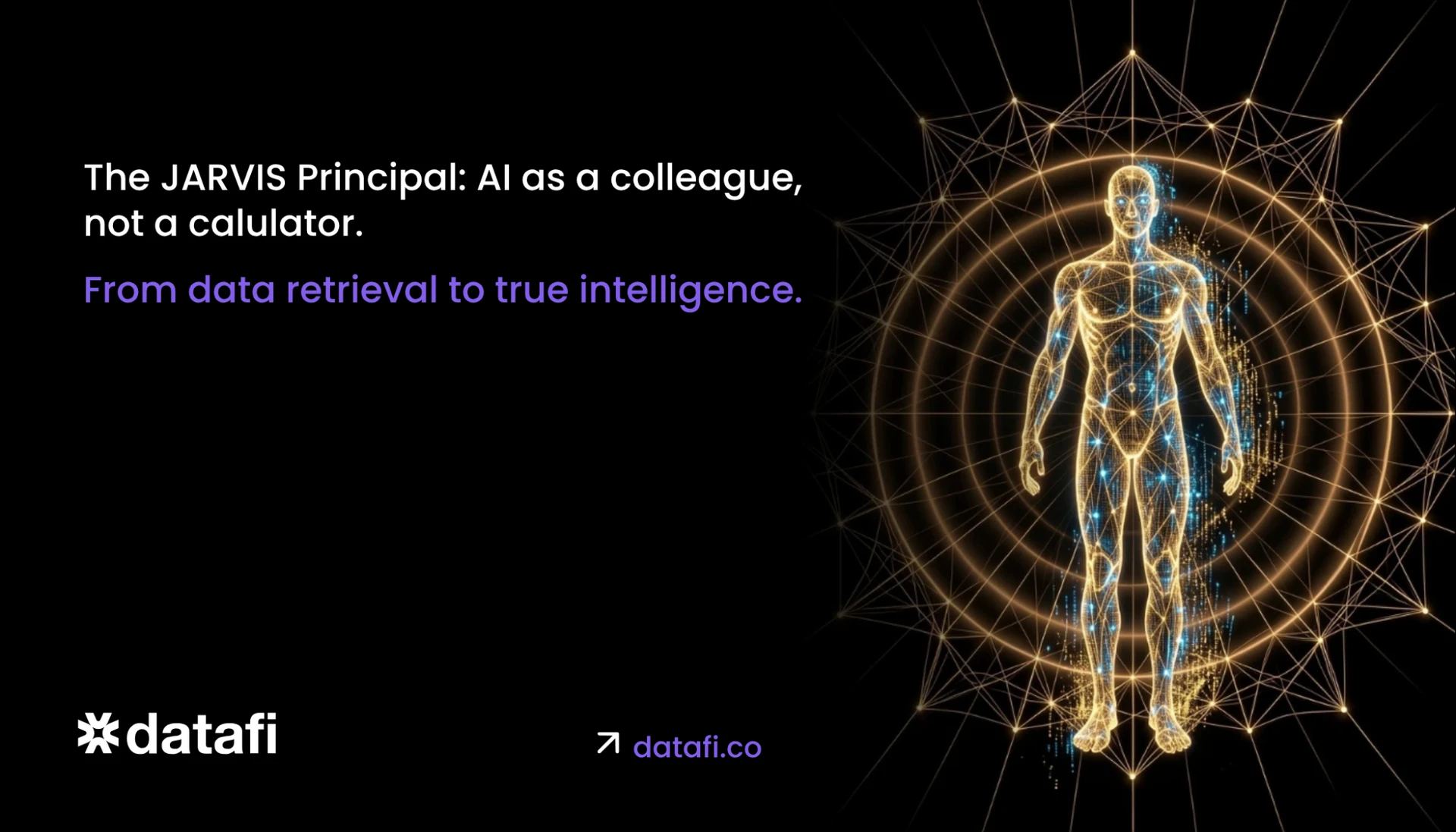
That vision has a name that has entered the cultural vocabulary: JARVIS. The idea of an AI that manages organizational complexity on behalf of an enterprise, not as a search engine or a report generator but as a genuinely intelligent operating partner with full awareness of the environment it serves, has captured the imagination of business leaders for good reason. It describes exactly what enterprise work actually needs.
JARVIS represented something specific: an AI with complete context that could be trusted with consequential decisions. It knew not just facts, but what those facts meant in relation to everything else. That distinction, between an AI that retrieves and one that understands and acts, is the central challenge and the central opportunity facing enterprise technology today.
We are at the beginning of the JARVIS moment in enterprise AI. The organizations that get there first will not do so by deploying more point solutions or layering chat interfaces on top of disconnected data silos. They will get there by unifying their AI systems into a vertically integrated foundation that gives AI the full context of the business.
The difference between AI that answers questions and AI that solves problems is not a matter of model intelligence. It is a matter of context, access, and architecture.
Why Point Solutions Are a Dead End
The current enterprise AI landscape is flooded with point solutions. AI tools for customer support. AI tools for financial forecasting. AI tools for supply chain visibility. Each one brilliant in isolation. Each one blind to everything else happening in the business.
This fragmentation is not merely an inconvenience. It is a structural barrier to the kind of transformative outcomes that AI systems are actually capable of delivering. When an AI system for predictive maintenance cannot see procurement lead times, and the supply chain AI cannot see maintenance schedules, and neither can see the customer commitments that operations teams are managing, the organization ends up with three expensive tools generating individually correct but collectively incoherent recommendations.
Solving this with integrations, custom data pipelines, and point-to-point connections is the equivalent of adding more lanes to a congested highway. It delays the problem without addressing its source. The source is a missing layer: a unified business context that every AI system and every agent can draw from and contribute to simultaneously.
The Vertically Integrated Imperative
At Datafi, our perspective is shaped by years of direct work with enterprise data ecosystems. We have seen what happens when organizations try to build meaningful AI outcomes on fragmented data infrastructure. The results are predictable: high implementation costs, low adoption, narrow value capture, and a growing gap between what AI promised and what it delivered.
The solution is not a better point solution. It is a vertically integrated data platform and AI technology stack that operates as a single system from the data source all the way to the business decision, regardless of where that data lives or what form it takes.
THE DATAFI AI OPERATING SYSTEM
Chat UI for All Users
Natural language access for every employee, technical or not, to the full power of the platform.
Autonomous Agents & Workflows
AI agents that operate, reason, and act across business functions without constant human direction.
Global Business Contextual Layer
A live, unified representation of business meaning, relationships, and intent built from the full data ecosystem.
Data Federation Without Ingestion
Access to the complete data ecosystem in place, with no movement, no replication, no latency.
Embedded Governance & Control Tower
Policy, access control, and audit capability built into the architecture, not bolted on afterward.
Each layer of this stack reinforces and depends on the others. A Chat UI without a contextual layer is a toy. A contextual layer without federated data access is a fiction. Agents without governance are a liability. The integration is the product. That is the vertically integrated principle that makes transformative AI outcomes possible.
The Contextual Layer: AI That Knows Your Business
The most important innovation in enterprise AI over the next several years will not be a more powerful language model. It will be the contextual layer that tells that model what everything means in the specific context of your business, your industry, your customers, and your strategy.
Consider what it means for an AI to truly understand a mid-size manufacturer. It is not enough to ingest documents and financial statements. The model needs to understand the relationship between a specific machine’s maintenance cycle and the customer orders that depend on that machine’s output. It needs to understand how a delay from a tier-two supplier propagates through assembly schedules and affects on-time delivery commitments to strategic accounts. It needs to understand that a spike in energy costs in one facility has ripple effects on margin models for a product line that leadership is about to present to the board.
This is what a genuine business contextual layer provides. Not a data warehouse. Not a vector database of documents. A living, dynamic model of how the business works, what its priorities are, what its constraints are, and what kinds of outcomes actually matter, continuously updated as the data ecosystem evolves. It is the layer that turns generic AI data analysis into reasoning that is specific to your enterprise.
This is the JARVIS principle applied to enterprise AI: not an assistant that retrieves information on request, but an operating intelligence that maintains a continuous, comprehensive understanding of the organization and acts on that understanding proactively. An AI that functions less like a search engine and more like the most informed, most reliable, most tireless member of the leadership team.
LLMs must know the full context of the business, have access to the complete data ecosystem, and function in fully autonomous roles to learn and solve hard business problems. This is what develops the contextual layer required for complex agents and workflows.
Every Employee, Every Role
One of the most consistent patterns we see across enterprise AI deployments is the assumption that AI is primarily a tool for technical users. Data scientists build models. Analysts run queries. Engineers maintain pipelines. And everyone else waits for a report to arrive.
This model is not sustainable and it is not necessary. A vertically integrated architecture with a Chat UI designed for non-technical users changes the distribution of AI value across the organization entirely. When the operations manager on the floor can ask a natural language question and receive an analysis grounded in real-time data from across the business, the ROI calculation for enterprise AI changes fundamentally.
The JARVIS vision was never about serving a single seat in the executive suite. The real power of AI systems with full business context is that it can serve every person in the organization simultaneously, calibrated to their role, their decisions, and their data access. The democratization of AI access is not about making everyone a data scientist. It is about giving every employee the ability to engage with the intelligence of the organization in a way that fits how they actually work.
Where AI Agents Deliver Transformative Outcomes
The use cases for autonomous AI agents operating within a fully contextual architecture are not hypothetical. They are emerging across industries with measurable business impact.
Predictive Maintenance & Asset Management
Agents that continuously monitor equipment telemetry, cross-reference maintenance history, supplier lead times, and production schedules to predict failures before they occur.
Operations Optimization
Continuous multi-variable optimization across logistics, labor, inventory, and demand signals, surfacing decisions with full context and recommended action.
Passenger & Customer Experience
Agents that anticipate friction in customer journeys before it occurs, coordinate resolution across operational systems, and personalize responses at scale.
Strategic Planning & Scenario Analysis
AI that builds, stress-tests, and compares strategic scenarios using real business data, compressing weeks of analyst work into hours of synthesis.
What these use cases share is not complexity for its own sake. What they share is the requirement that AI be able to see across organizational boundaries, act without constant instruction, and understand not just individual data points but the meaning of those data points in relation to the business as a whole.
Governance Is Not a Constraint. It Is the Foundation.
As AI agents take on more consequential roles in enterprise workflows, the question of governance becomes existential. Not in the abstract sense of AI safety discourse, but in the immediate, practical sense of enterprise risk management. Who authorized this agent to access this data? What policy governed this recommendation? How do we audit a decision that an autonomous system made at 2am?
These are not questions that can be answered after the architecture is built. They must be answered by the architecture itself. Embedding governance, data access policy, audit trails, and control mechanisms into the foundational layer rather than treating them as an overlay is what makes autonomous AI viable in regulated and risk-sensitive industries like financial services, life sciences, energy, and healthcare.
This is why the Control Tower and embedded policy layer in the Datafi operating system are not features. They are prerequisites. The ability to deploy AI agents in critical business functions depends entirely on the organization’s ability to define, enforce, and monitor the boundaries within which those agents operate.
The Competitive Advantage Is Not the Model. It Is the Architecture.
Every enterprise in the world has access to the same large language models. GPT-4, Claude, Gemini, Llama, and their successors are increasingly commoditized infrastructure. The competitive advantage in enterprise AI is not which foundation model a company deploys. It is whether that company has built the architecture required to give that model access to meaningful, complete, governed business context and the ability to act on that context with precision.
Organizations that invest now in building a vertically integrated AI operating system, one that federates their data platform ecosystem without requiring ingestion or replication, that develops a global business contextual layer, that extends AI access to every employee through natural language interfaces, and that deploys autonomous agents within a governed framework, are building a structural advantage that compounds over time.
Every workflow automated is institutional knowledge encoded. Every agent deployed learns the business more deeply. Every interaction through the Chat UI contributes to a richer contextual layer. The architecture, once established, becomes a flywheel.
The JARVIS Principal Is Not Fiction Anymore
The idea of an AI that manages organizational complexity with full context, continuous awareness, and autonomous action has moved from imagination into engineering. Every technical component required to build it exists today. The models are capable. The data is there. The compute is available. What has been missing is the architecture to bring it together in a way that is unified, governed, and accessible to every person in the organization, not just the engineers building it.
That is exactly what a vertically integrated AI operating system provides. Not AI as a department. Not AI as a tool for the technical minority. AI as the operating nervous system of the enterprise, continuously learning, continuously acting, continuously surfacing the insights and decisions that move the business forward.
The future of work is not one where AI replaces human judgment. It is one where every employee is amplified by an AI that knows the business as well as they do and can act on that knowledge faster, more comprehensively, and more reliably than any human team working alone. The organizations that build toward that future today are the ones that will define their industries tomorrow.
Ready to leverage the operating system for business AI?
Discover how the Datafi platform helps mid-enterprise organizations unify data, deploy AI agents, and deliver outcomes at scale.