

The Business AI Operating System Built for Every Employee, Not Every Engineer
Why mid-enterprise and enterprise organizations are choosing Datafi over assembling a fragmented stack of AI tools from Azure and Databricks to achieve real, autonomous AI outcomes across the business.
There is a point in every enterprise AI initiative when the vision collides with the architecture. The vision is compelling: an organization where AI agents handle the analytical burden, where every employee interacts with business data as naturally as a conversation, where workflows that once required weeks of analyst time complete autonomously in hours. The architecture, too often, is a sprawling assembly of Azure services, Databricks notebooks, custom APIs, and bolt-on chat interfaces that bear no resemblance to the vision that was sold to the board.
This gap is not a failure of ambition. It is a structural problem. The dominant approach to enterprise AI, led by platforms like Microsoft Azure and Databricks, was designed to serve data engineers and data scientists. It was not designed to serve the financial analyst in accounting, the operations manager on the warehouse floor, or the executive team building a five-year strategic plan. When organizations attempt to bridge that gap with point solutions layered on top of cloud infrastructure, they compound complexity, extend timelines, and create exactly the kind of organizational friction that AI was supposed to eliminate.
Datafi was founded on a fundamentally different premise: that transformative AI outcomes require a vertically integrated operating system purpose-built for business, not a collection of infrastructure primitives assembled by an engineering team.
Transformative enterprise AI outcomes require a vertically integrated operating system purpose-built for business users. Assembling fragmented tools from Azure and Databricks creates compounding complexity that extends timelines and defeats the purpose of AI adoption.
The Stack Assembly Problem
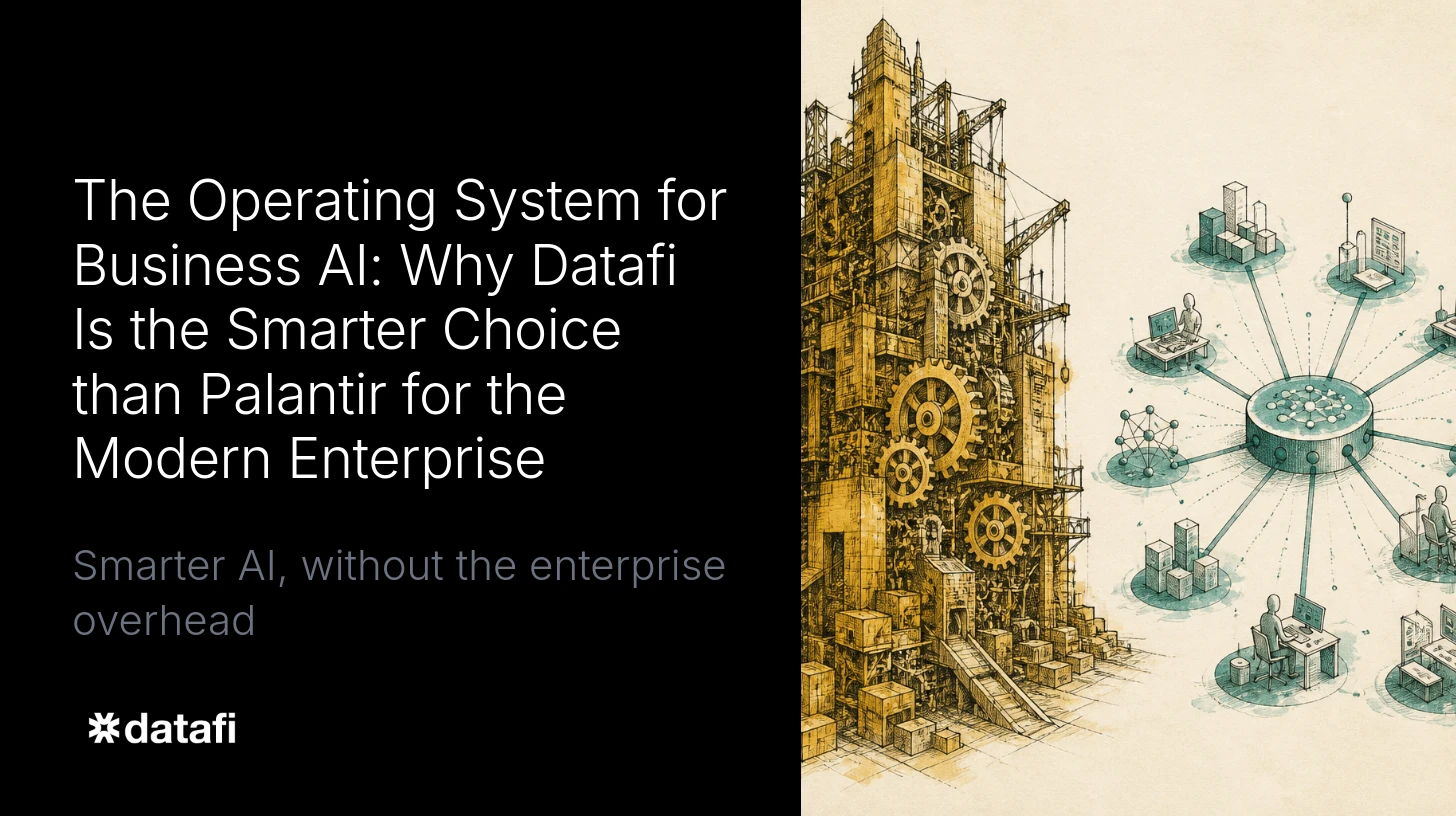
Microsoft Azure and Databricks each offer powerful individual capabilities. Azure provides scalable cloud infrastructure and a broad portfolio of AI services. Databricks delivers a capable data lakehouse environment for data engineers and analytics workloads. Used together, they can support meaningful data work. But when organizations attempt to deploy AI across the enterprise using these platforms, they encounter a structural limitation that no amount of integration work can fully resolve: these tools were not designed as a unified system for business AI, and every capability gap must be filled with something else.
| Azure + Databricks Approach | Datafi Business AI OS | |
|---|---|---|
| Integration | Separate tools requiring deep integration | Unified data, governance, agents, Chat UI |
| Chat Interface | Chat interfaces built for developers | Chat designed for non-technical business users |
| Agent Workflows | Agent workflows require custom engineering | Agent workflows configurable without engineering |
| Ecosystem | Deep dependency on Microsoft ecosystem | Connects to the full data ecosystem |
| Business Context | Business context spread across disconnected systems | Business context, policies, and control built-in |
| Time to Value | Months to production for non-technical workflows | Business users deploy AI workflows immediately |
| Cost | High total cost across licensing and talent | Predictable SaaS platform economics |
The stack assembly problem is compounded for mid-enterprise organizations that operate across a broad data landscape. When business data lives in Salesforce, SAP, Oracle, NetSuite, industry-specific applications, and decades of structured and unstructured data assets, the Microsoft-centric integration model creates an immediate disadvantage. Extracting full value requires either migrating data into the Azure ecosystem or building and maintaining a web of connectors that adds fragility and cost at every layer.
Vendor lock-in is not merely an IT concern. It is a strategic constraint. When an organization’s AI capability is architecturally dependent on a single vendor’s roadmap, pricing decisions, and ecosystem boundaries, it surrenders the flexibility to adopt best-in-class tools as the market evolves. In a technology landscape moving as rapidly as applied AI, that rigidity carries serious long-term risk.
Context is the Foundation of Autonomous AI
The most important insight in enterprise AI is one that most platform vendors have not yet internalized: a large language model performing business work is only as capable as the context it has access to. An AI agent that can answer questions about a data warehouse is not the same as an AI agent that understands the relationships between your customers, your operations, your cost structure, your regulatory environment, and the strategic decisions your leadership team is wrestling with today.
LLMs will not deliver transformative business outcomes by answering questions. They will deliver those outcomes when they have access to the full context of the business, the complete data ecosystem, and the capacity to function in fully autonomous roles where they learn and solve hard problems.
This is the contextual layer problem. Building it on top of disconnected infrastructure is possible, but it requires engineering work that most organizations cannot sustain, and it produces a context layer that is perpetually incomplete because it reflects only what the engineering team had time to connect. Datafi’s architecture approaches this differently: the contextual layer is built into the platform by design, not assembled after the fact.
When Datafi connects to an organization’s data ecosystem, it is not simply creating pipelines to move data. It is building a unified representation of business context that AI agents can draw on across every interaction, every workflow, and every autonomous decision. That context includes the data, the policies governing how data can be used, the business rules that reflect how the organization operates, and the governance structures that ensure AI actions remain auditable and aligned with organizational intent.
Chat Designed for Business, Not for Developers
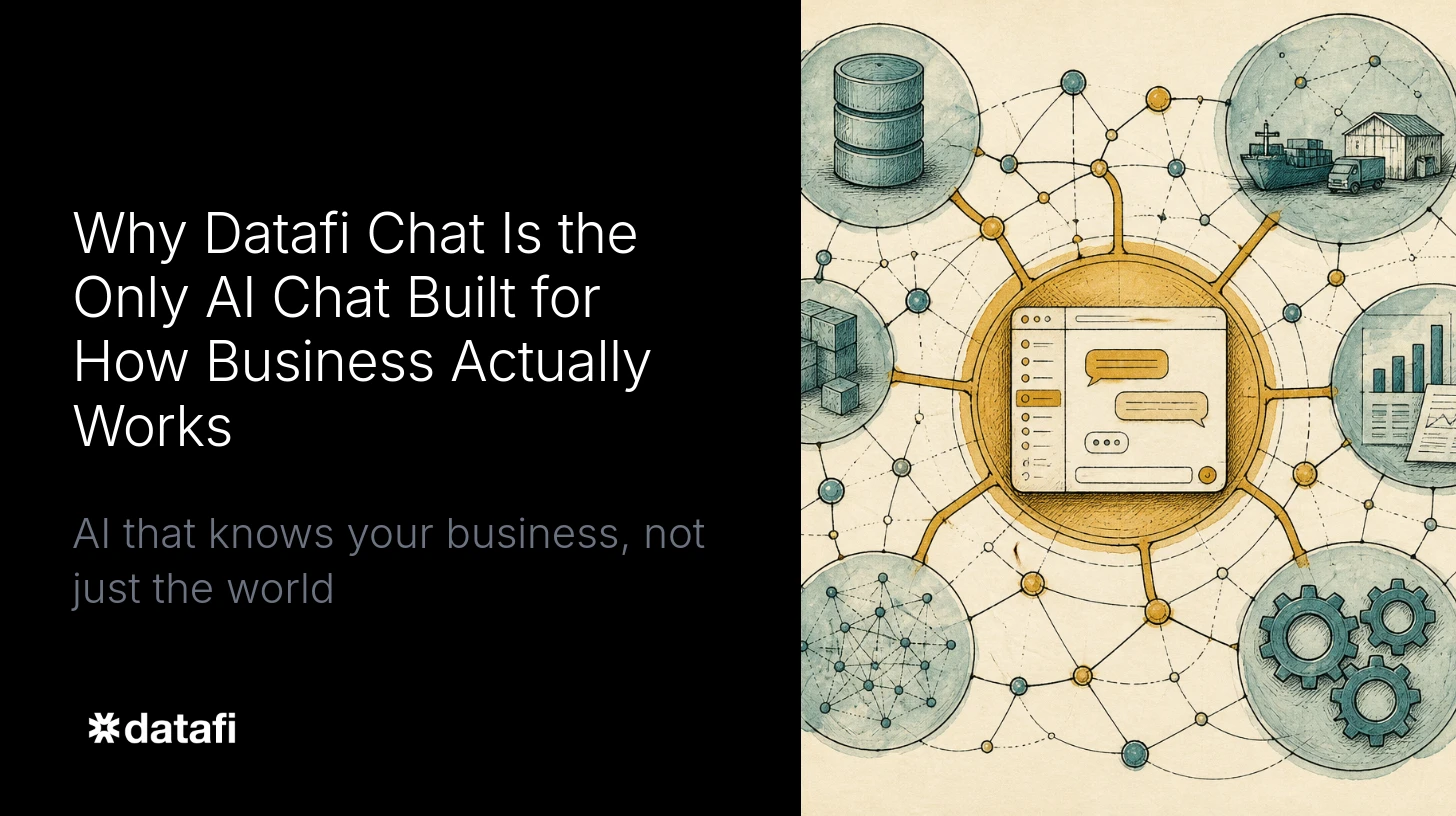
The chat interface is where enterprise AI strategy most visibly succeeds or fails for the majority of employees. Most AI tools available today were designed with a technical user in mind. They reward prompt engineering expertise, tolerate ambiguity in ways that produce unreliable results for business questions, and require users to understand something about how the underlying system works in order to get reliable answers.
Datafi Chat was designed from first principles for the business user. It understands the business vocabulary of the organization, knows which data sources are authoritative for which questions, surfaces relevant context proactively, and connects natively to the agent workflows that make AI genuinely productive. When a logistics manager asks a question about fleet utilization trends, they receive an answer grounded in the actual data, with the ability to immediately extend that inquiry into an automated workflow, a recurring report, or a triggered alert, without writing a single line of code or submitting a ticket to the data team.
This seamless integration between the chat experience and agent workflows is architecturally significant. In most competing approaches, the chat interface and the agent layer are separate systems that communicate through APIs. Datafi treats them as a single, unified experience because that is what business users actually need: a coherent interface where asking a question and initiating an intelligent workflow are the same gesture.
Unified AI Across the Organization
The value of a Business AI Operating System is realized not in a single use case but across the full breadth of organizational operations. When every employee has access to a unified data experience and the AI agents that make that data actionable, the efficiency gains compound across every function.
01. Predictive Maintenance and Asset Management
AI agents continuously monitor asset performance data, identify failure probability patterns, and initiate maintenance workflows before breakdowns occur, reducing unplanned downtime and extending asset life cycles.
02. Operations Optimization
Autonomous agents analyze operational data across supply chains, logistics networks, and production environments to surface optimization opportunities and execute workflow adjustments that would require significant analyst time to identify manually.
03. Strategic Planning and Forecasting
AI-powered planning workflows draw on the full business context to model scenarios, pressure-test assumptions, and surface insights that enable leadership teams to make higher-quality decisions faster than traditional analytical processes allow.
Passenger and Customer Experience
Real-time personalization and service workflows driven by unified customer data.
Financial Operations
Automated analysis, anomaly detection, and reporting across the financial data ecosystem.
Workforce Intelligence
AI-assisted scheduling, performance analysis, and capacity planning for operational teams.
These outcomes are not theoretical. They represent the practical application of a platform designed to give AI agents enough context to perform genuinely complex business reasoning, not just to retrieve and summarize information. The distinction matters because retrieval and summarization, while useful, are incremental improvements. Autonomous reasoning, workflow execution, and adaptive learning are transformative.
The Mid-Enterprise Advantage
Hyperscale cloud vendors design their products for hyperscale customers. The assumptions embedded in the architecture, the pricing models, the implementation requirements, and the support structures all reflect organizations with large dedicated engineering teams, substantial cloud budgets, and the time and resources to sustain multi-year platform rollouts. Mid-enterprise customers frequently find themselves acquiring enterprise-scale complexity while receiving startup-scale support.
Datafi’s approach inverts this dynamic. A vertically integrated Business AI Operating System eliminates the need for mid-enterprise organizations to hire a team of specialists to assemble and maintain a custom AI stack. The platform provides what those organizations actually need: a unified data platform that connects to their existing data landscape, regardless of which vendors that landscape includes, and delivers AI capability to every employee without requiring every employee to become technically proficient in the underlying infrastructure.
The freedom to choose matters. Datafi connects to the full data ecosystem, including Microsoft, Salesforce, Oracle, SAP, Google Cloud, AWS, and hundreds of industry-specific data sources, without requiring organizations to migrate data into any single vendor’s environment. Mid-enterprise customers preserve the flexibility to use best-in-class tools across their data landscape while gaining a unified AI operating layer above it.
This also means that organizations are not betting their AI transformation on a single vendor’s continued investment in capabilities they need. Datafi is built to integrate with the evolving AI model landscape, including the most capable frontier models, ensuring that improvements in foundational AI capability translate directly into improvements in the business outcomes Datafi delivers.
Governance and Control by Design
Enterprise AI that operates without governance is not enterprise AI. It is a liability. As AI agents take on more critical thinking and workflow automation roles, the ability to understand what they did, why they did it, and whether the results align with organizational policy becomes essential, not optional. Organizations in regulated industries, organizations managing sensitive customer data, and organizations with complex internal compliance requirements need governance that is built into the architecture, not bolted onto it after deployment.
Datafi’s integrated governance model means that the policies governing data access, the rules shaping AI agent behavior, and the audit trails documenting AI actions are part of the same system as the data layer and the agent layer. There is no gap between the governance intent and the governance execution because they operate within the same platform. This is a structural advantage that becomes more significant as AI takes on more consequential roles across the business.
From Answering Questions to Solving Problems
The central challenge of enterprise AI in 2026 is not generating answers. It is generating outcomes. Every major vendor in this space, from Power BI dashboards bolted onto Azure, to standalone AI tools layered on top of a data lake, can produce systems that answer questions competently. What the market has not solved, until now, is the gap between the AI that answers questions and the AI that autonomously executes the workflows, makes the decisions, and learns from the results in ways that change how the business operates.
That gap exists because solving business problems autonomously requires more than a capable language model. It requires a model that has access to the full context of the business, a genuinely connected data integration platform that keeps information current across every source, governance structures that allow autonomous action within defined boundaries, and an interface that every employee can use without technical training. These requirements are not independent. They are interdependent, and they can only be fully satisfied by a platform built to integrate them from the ground up.
Datafi is that platform. It is not a faster path to the same destination that Azure and Databricks are building toward. It is a different destination entirely: an organization where AI functions as a genuine operational intelligence, not a sophisticated search tool, and where the competitive advantage created by that intelligence is accessible to every employee, not just the team that built the infrastructure.
The organizations that will lead their industries over the next decade are not the ones that assembled the most sophisticated data engineering stack. They are the ones that deployed AI broadly, deeply, and autonomously across every function of the business. Datafi exists to make that outcome achievable without requiring a decade to get there.