

There is a question that surfaces in nearly every serious enterprise AI conversation, usually after the initial excitement has worn off and the real work of deployment begins. It is not whether the model is capable. It is not whether the demo was impressive. It is far more practical, and far more consequential: can we trust this system with the data that actually runs our business?
That question is where most enterprise AI ambitions quietly stall. An organization can prove a compelling pilot in a sandbox, isolated from anything sensitive. The moment the workflow needs to touch customer records, financial systems, employee data, or regulated information, the conversation changes. Security teams get involved. Legal gets involved. Procurement asks for documentation. And the gap between a promising prototype and a production system that the enterprise will actually trust turns out to be measured not in model performance, but in governance, security, and proof.
This is the gap that SOC 2 compliance is designed to close. And for an operating system for business AI, where the entire premise is giving AI governed access to the complete data ecosystem of an organization, SOC 2 is not a checkbox at the end of the journey. It is a load-bearing part of the architecture.
SOC 2 compliance is the formal, independently audited proof that an AI platform can be trusted with sensitive enterprise data. For an operating system for business AI, where AI agents need broad access to operational systems to solve real problems rather than just answer questions, that trust is the precondition for everything else. Compliance is what makes broad, autonomous, governed AI deployable at enterprise scale.
What SOC 2 actually proves
SOC 2 is an auditing framework developed by the American Institute of Certified Public Accountants. It evaluates how a technology provider handles data against a set of Trust Services Criteria: security, availability, processing integrity, confidentiality, and privacy. A SOC 2 report is not a self-assessment or a marketing claim. It is the result of an independent auditor examining a company’s controls and verifying, with evidence, that those controls exist and operate as described.
There are two types of reports worth understanding. A Type I report attests that the right controls are designed and in place at a single point in time. A Type II report goes further, verifying that those controls operated effectively over a sustained period, typically six months to a year. Type II is the more demanding standard because it proves consistency, not just intent. It demonstrates that security is operationally real, day after day, not a snapshot assembled for an audit.
For a buyer, this distinction matters enormously. Anyone can claim to take security seriously. A SOC 2 Type II report is third-party, evidence-based proof that they do, examined by an auditor with no incentive to flatter.
Why this matters more for an operating system than for a point tool
A narrow AI tool that answers questions from a bounded set of documents carries a bounded risk. If it only ever sees a curated, low-sensitivity dataset, the security surface is small. Many AI products are deliberately scoped this way, and that scoping is part of why they feel safe.
But that same scoping is precisely why those tools cannot solve hard business problems. The most valuable enterprise AI work, the critical thinking workflow automation that we increasingly see customers reaching for, requires the opposite of narrow access. An agent that reconciles a financial discrepancy needs to read across the ERP, the general ledger, and the systems where transactions actually originate. An agent that resolves a supply chain exception needs operational data, supplier records, and real-time signals. The frontier of enterprise AI is agents that analyze, synthesize, and act across many systems. That frontier is, by definition, a frontier of broad data access.
This is the central tension of business AI. The more useful you want AI to be, the more of the business it needs to see. And the more of the business it can see, the more the question of trust dominates everything.
The AI tools that feel safest are usually the ones scoped too narrowly to solve real problems. The AI that can actually transform operations needs broad, governed access to the business, which raises the stakes on security enormously. An operating system resolves this paradox by making governance native to the architecture, and SOC 2 is the independent proof that the resolution holds.
An operating system for business AI is built to resolve that tension rather than avoid it. It connects to the complete data ecosystem, structured and unstructured, operational and historical, first-party and external, as a living, governed connection layer. It does not earn trust by limiting what AI can reach. It earns trust by governing how AI reaches it. SOC 2 is the framework that proves the governance underneath that access is real.
Compliance as architecture, not a bolt-on
It is tempting to treat compliance as something you add at the end, a layer of documentation and policy applied on top of a system that was built without it in mind. In our experience, that approach does not survive contact with enterprise scale.
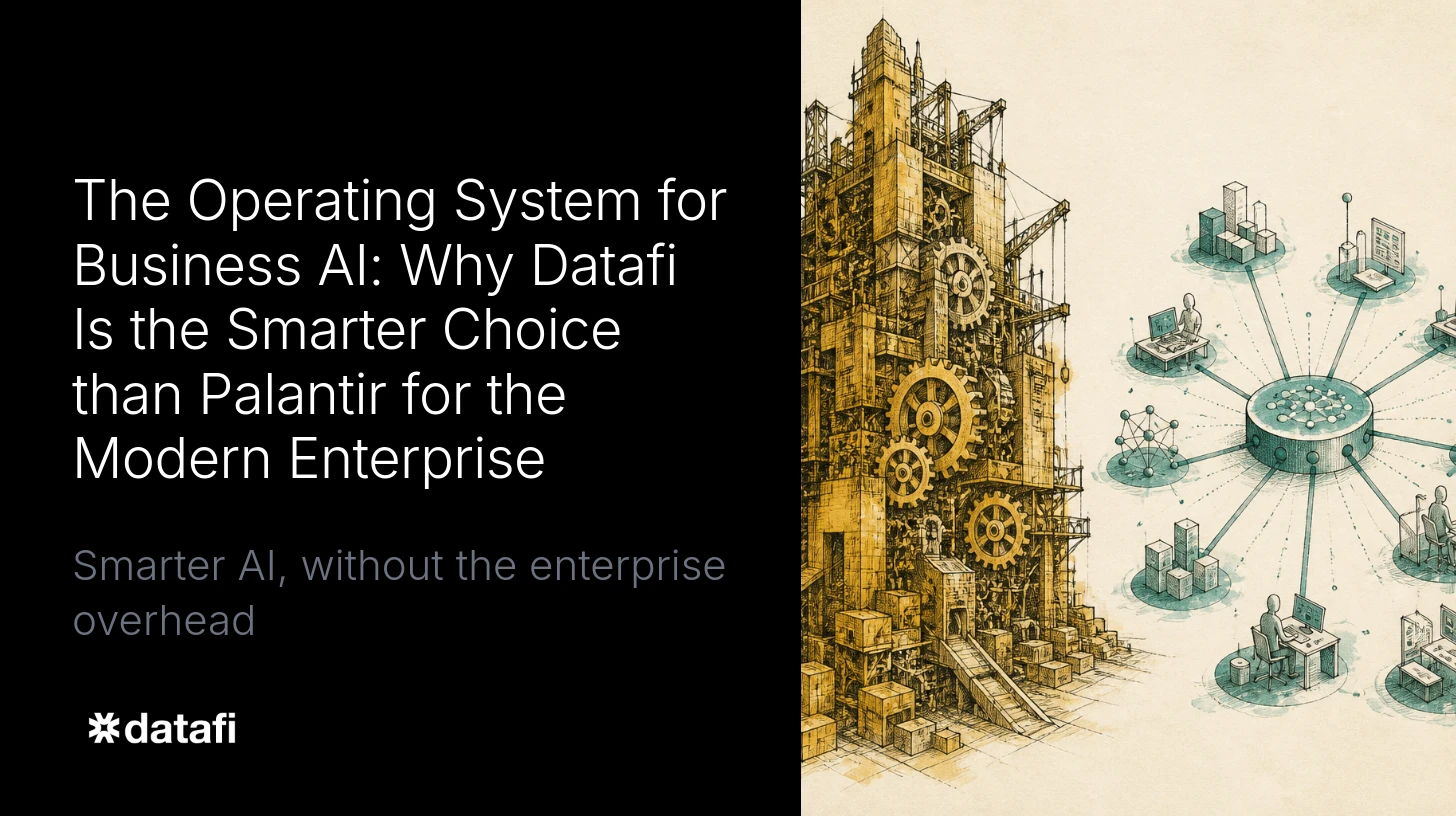
Governance becomes the bottleneck for real adoption precisely when it is bolted onto a patchwork of disconnected tools. Every new agent, every new data source, every new workflow forces the organization to renegotiate security and compliance from scratch. That fragmentation slows everything down at exactly the moment adoption should be accelerating.
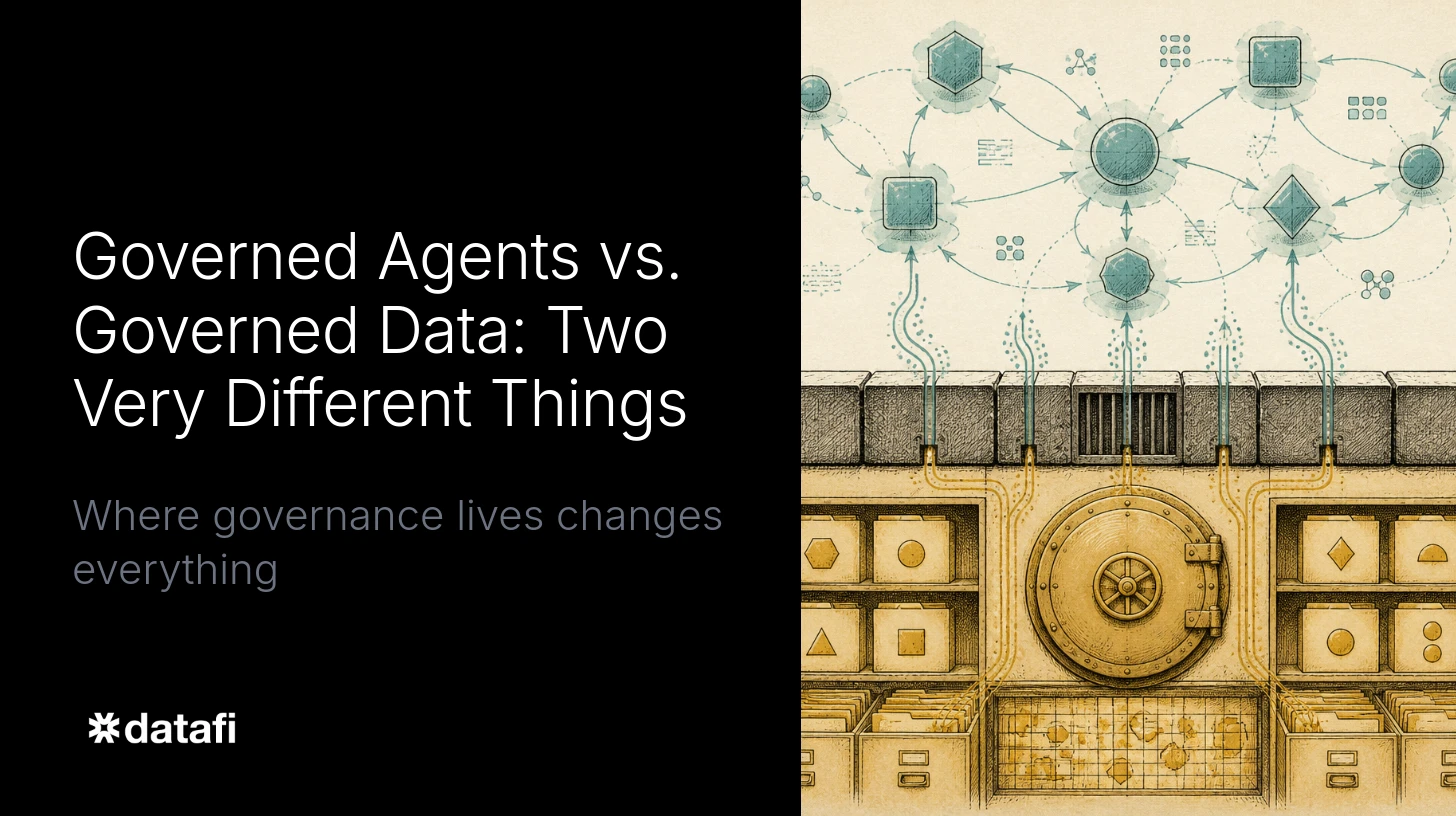
The alternative is to make governance and security native to the operating layer itself, so the organization defines its guardrails once and enforces them everywhere agents and workflows run. When compliance is architectural, SOC 2 stops being a periodic scramble and becomes a natural expression of how the platform already works. The controls an auditor wants to see, who can access what data under which conditions, how access is logged, how activity is monitored, how outcomes are made auditable, are the same controls that make broad AI deployment safe in the first place.
This is the difference between a platform that passes an audit and a platform that embodies what the audit is checking for. The first treats compliance as a hurdle. The second treats it as evidence of a design that was correct to begin with.
The benefits compound across the organization
When an operating system for business AI is built on a SOC 2 foundation, the advantages reach well beyond the security team.
For leadership, SOC 2 turns a leap of faith into a documented decision. It provides the assurance that AI can be expanded across functions without expanding uncontrolled risk. The organizations that win with AI are the ones that can grow capability without growing exposure, and compliance is what makes that expansion defensible to a board, a regulator, or a customer.
For security and risk teams, a unified, audited governance layer replaces the impossible task of chasing controls and logs across a dozen separate AI vendors. Instead of governing tool sprawl, they govern one operating system, with one consistent framework, one observable record of activity, and one place to prove accountability after the fact. This is a profound reduction in operational burden.
For data teams, compliance built into the platform means new data sources can be brought into the AI ecosystem with consistent controls from day one, rather than requiring a fresh security review for every connection. The feedback loop on how data is being used in AI workflows becomes clearer, which raises the quality of the decisions those workflows support.
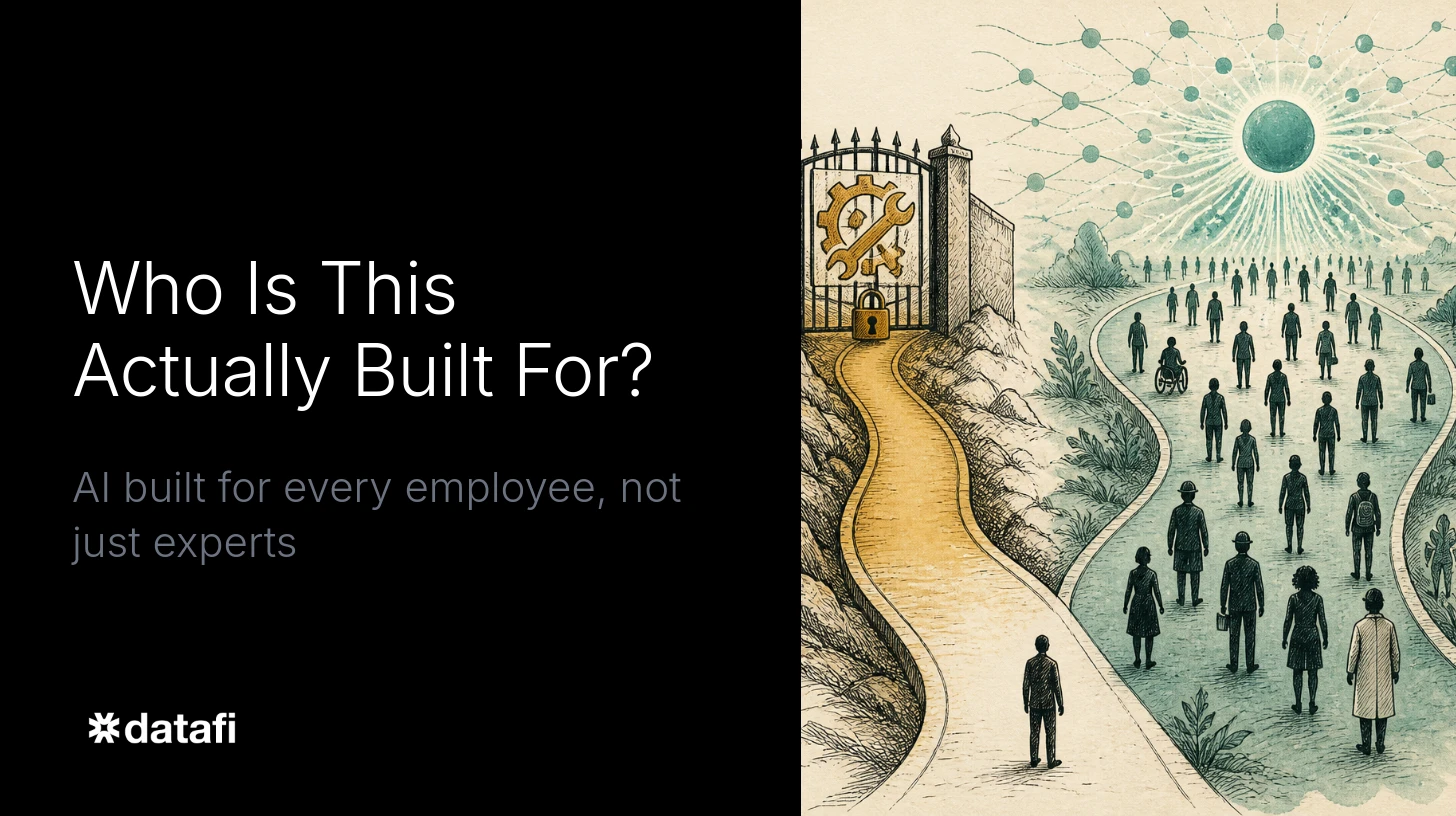
For every employee, the benefit is quieter but no less important. A governed, compliant foundation is what makes it possible to put a chat interface, designed for non-technical users, in front of the entire workforce without putting the business at risk. People can ask questions, run workflows, and act on operational data without needing to understand the systems underneath, because access and behavior are governed consistently and provably behind the scenes. Compliance is what lets a unified data experience extend to everyone rather than remaining the privilege of a few data practitioners.
From answering questions to solving problems, safely
The reason any of this matters is that the destination for enterprise AI is not a smarter chatbot. The destination is AI that acts. We see customers wanting to use AI in genuinely critical roles: workflow automation, analytical reasoning, and the kind of cross-functional problem solving that has historically required a skilled human moving between systems.
For LLMs to take on those roles, they need the full context of the business. They need access to the complete data ecosystem. They need to function with meaningful autonomy, learning from outcomes and operating across systems rather than within a single bounded source. This is what it takes to build the contextual layer that complex agents and workflows depend on, and it is the difference between AI that answers questions and AI that solves problems.
But autonomy without accountability is not something any serious enterprise will deploy, and rightly so. The more independently an agent operates, the more essential it becomes to prove what it did, what data it touched, what instructions it followed, and what actions it produced. Observability and audit are not separate from autonomy. They are what make autonomy deployable.
This is the deeper reason SOC 2 belongs at the center of an operating system for business AI rather than at its edges. The framework asks exactly the questions that autonomous AI must be able to answer: Is access controlled? Is activity logged? Can outcomes be traced and proven? A platform that can satisfy a SOC 2 auditor is a platform that has already built the foundation autonomous AI requires. The compliance work and the capability work turn out to be the same work.
The practitioner’s view
My perspective on this comes from years of working at the intersection of data and AI, and watching where transformative outcomes actually come from. They do not come from the most impressive model or the flashiest demo. They come from the conditions that allow AI to action data responsibly: full business context, governed access to the right systems, and the ability to act with accountability rather than merely retrieve information.
Compliance is often framed as a constraint on AI, the thing that slows ambition down. I would argue the opposite. For an operating system designed to give AI broad, autonomous, governed access to the enterprise, SOC 2 is not what holds the ambition back. It is what makes the ambition real. It is the proof that the access is safe, the autonomy is accountable, and the trust the enterprise is being asked to extend is one the platform has earned and can demonstrate.
The organizations that will lead with AI are not the ones that move fastest in a sandbox. They are the ones that can move AI into the operational fabric of the business, across every function and every employee, without ever losing control of it. A SOC 2 foundation is how an operating system for business AI makes that possible: expanding capability without expanding risk, and turning the question every enterprise eventually asks, can we trust this with our business?, from a reason to hesitate into a reason to move.