


There is a persistent assumption embedded in the way life sciences organizations approach regulatory submissions: that the bottleneck is document management. Teams spend enormous energy on authoring systems, document control workflows, version tracking, and submission formatting. The implicit belief is that if the documentation process were more disciplined, faster, or better organized, the submission would be better too.
This assumption is wrong. And it is costing organizations years.
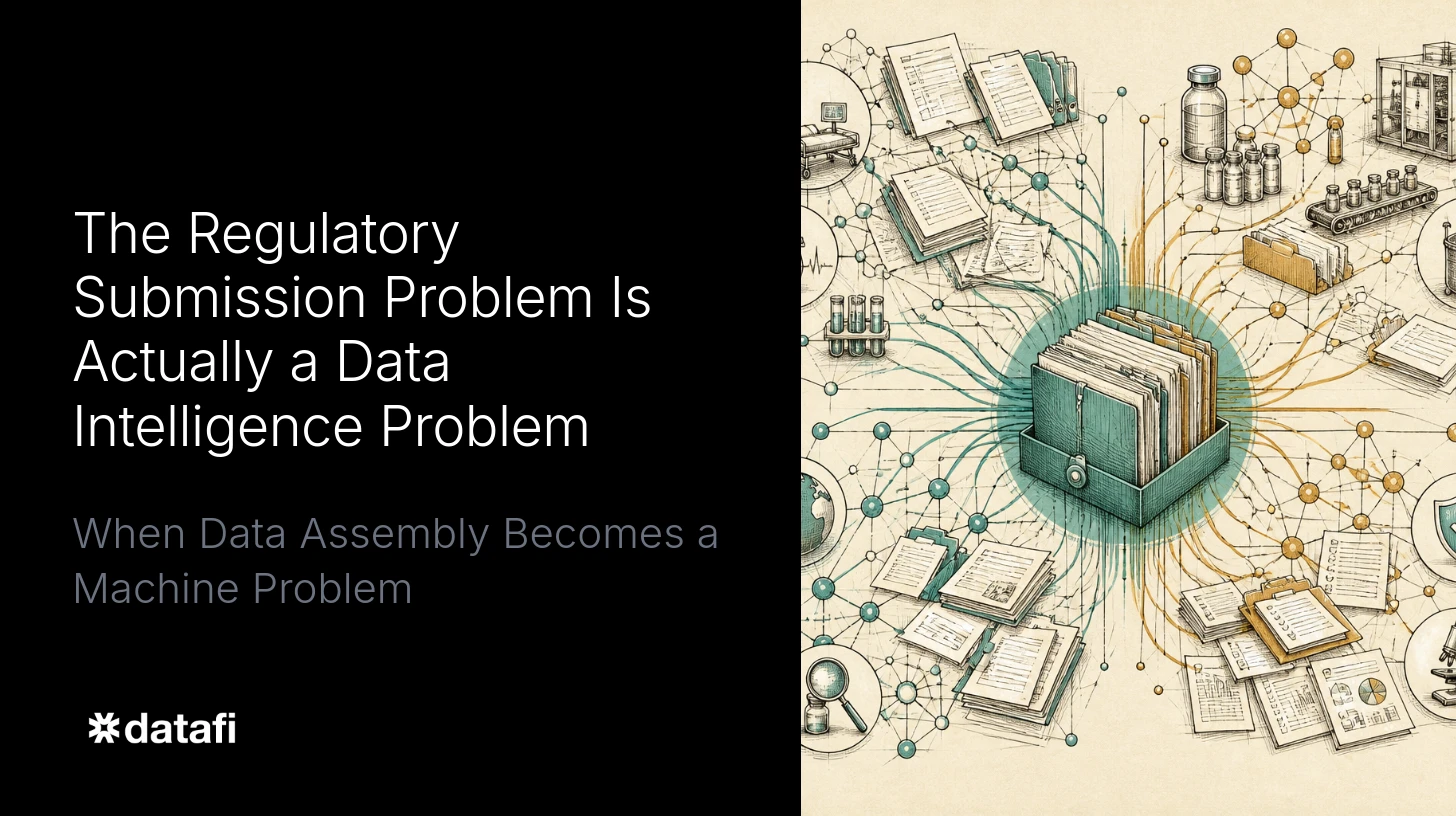
The chronic delays, the back-and-forth with agencies, the last-minute scrambles to reconcile inconsistencies across a dossier, the missed questions from reviewers that should have been anticipated, the discrepancies between the clinical narrative and the safety data, the pharmacokinetic summaries that do not align with the biostatistics section, none of these are fundamentally documentation failures. They are data intelligence failures. They happen because the people responsible for building a submission do not have access to a unified data integration platform that connects the full evidence base they need to make confident, accurate, and consistent claims.
The document is a downstream artifact. The intelligence that drives it is the problem.
Regulatory submission delays are not documentation failures. They are data intelligence failures rooted in fragmented, disconnected evidence bases across clinical, safety, manufacturing, and quality functions.
The Submission Is Not the Work. The Work Is the Work.
A regulatory submission is, at its core, a structured argument. It is an evidence-based case, made to a skeptical agency audience, that a product is safe, effective, and consistently manufactured. The strength of that argument depends entirely on the quality, completeness, and internal consistency of the evidence assembled to support it.
The challenge is that the evidence lives everywhere. Clinical trial data is in a statistical computing environment. Safety data is in a pharmacovigilance system. Manufacturing data is in quality management and ERP systems. Preclinical findings are in lab information management systems. CMC documentation is tied to process development records. And the collective understanding of what all of it means, the institutional knowledge about why certain decisions were made, what anomalies were observed, and how they were resolved, is distributed across the people who ran the studies, wrote the protocols, and managed the deviations.
Getting all of this into a coherent submission requires teams to spend the majority of their time not writing, but searching: locating the right data, reconciling conflicting versions, confirming that what the clinical summary says is actually consistent with what the integrated clinical and statistical report says, and verifying that the safety narrative reflects every adverse event coded in the database. That search-and-reconcile work is where months go. And it is almost entirely a data access problem.
When the data ecosystem is fragmented, every decision in the submission process requires a human to act as a bridge. A Regulatory Affairs writer needs a number from the biostatistics team. A CMC author needs a manufacturing yield summary from operations. A safety writer needs a listing from the pharmacovigilance database. Each of these requests creates a queue, a delay, an opportunity for miscommunication, and a version control risk. Multiply this across hundreds of data dependencies in a single dossier and it becomes clear why submissions routinely run late and why deficiency letters land on topics that seem like they should have been obvious.
What Agencies Are Actually Asking
When the FDA issues a Complete Response Letter, or when the EMA returns a List of Questions, the queries are rarely about the documents themselves. They are about the evidence. They want to understand the benefit-risk profile more completely. They want to see whether a subgroup analysis changes the interpretation of a primary endpoint. They want reconciliation between the Summary of Clinical Pharmacology and the individual study reports. They want to know whether the manufacturing process is robust enough to maintain quality at commercial scale.
These are data questions. Answering them rapidly and confidently requires teams to have deep, integrated access to the full evidence base, not just the documents that summarize it. The organizations that can respond to an agency query in two weeks instead of two months are not better at writing. They are better at accessing, assembling, and reasoning across their data.
This distinction matters enormously at the leadership level. Regulatory Affairs leaders who frame submission readiness as a documentation discipline problem will continue to invest in authoring tools, document management platforms, and process governance. These investments are not wrong, but they are incomplete. The constraint is upstream. The submission cannot be better than the data intelligence that feeds it.
The Context Layer Is the Competitive Advantage
Consider what it would mean for a Regulatory Affairs team to have a genuinely integrated view of the product’s complete evidence base, across all functions, in real time, with the ability to ask questions of that data in plain language and receive answers grounded in the actual records rather than summaries of summaries.
A medical writer could ask whether any subgroup in the Phase 3 population showed a safety signal that the primary analysis did not surface. A CMC lead could verify whether every batch released during the clinical program met the specification ranges currently claimed in the dossier. A regulatory strategist could model how the benefit-risk narrative holds up under a more conservative interpretation of the primary endpoint responder rate. A safety physician could confirm that every preferred term in the adverse event coding maps consistently to the same narrative language across all study reports.
None of these questions require new data. The data already exists. What is missing is the AI data analysis layer that connects it, enabling teams to move across functional data domains fluidly and ask complex questions that require synthesizing information from multiple sources simultaneously.
This is what Datafi is built to provide. The Datafi AI operating system is a vertically integrated data and AI stack that connects an organization’s complete data ecosystem to an AI layer that can reason across it, govern access to it, and take action within it. The data does not have to move. The intelligence comes to where the data lives, and the people who need answers get them through a natural language interface that requires no technical skill to operate.
For regulatory submissions, this means that the dossier authoring process is no longer constrained by the speed at which human intermediaries can retrieve, reconcile, and deliver data. It means that the evidence base is continuously accessible to everyone who has a legitimate need to query it. It means that AI agents can perform consistency checks across document sections autonomously, flagging discrepancies before they become deficiency letter items. And it means that when an agency question arrives, the team can answer it from a position of complete situational awareness rather than racing to locate records they have never fully connected before.
Why Point Solutions Cannot Solve This
The instinct in many organizations is to address this challenge with targeted tools. A better clinical data repository. A more capable pharmacovigilance platform. A purpose-built regulatory information management system. These investments improve individual functions, but they do not solve the integration problem. In many cases, they deepen it, adding one more specialized system that holds important data in a format and governance model that is incompatible with everything around it.
The regulatory submission bottleneck is fundamentally a cross-functional data problem. The evidence base for a product spans scientific, clinical, manufacturing, and quality domains that have historically been managed in silos because the technology required to connect them safely, at the level of governance and data control demanded by a regulated environment, simply did not exist.
That technology now exists. But it requires a different architectural philosophy than point solutions can offer.
What is needed is a data integration platform that can sit above the existing data ecosystem without requiring it to be rebuilt, that can enforce the access policies and audit trails required in a regulated environment, that can expose the full evidence base to AI reasoning without exposing sensitive records to actors who should not see them, and that can deliver answers through an interface simple enough for a Regulatory Affairs professional to use without filing a request with IT. Datafi is designed precisely around this architecture: a governance layer, a data access layer, a conversational AI layer, and an agentic workflow layer, all integrated and all operating against the data where it lives.
From Reactive to Anticipatory
The most significant long-term consequence of solving this problem is not faster submissions. It is better ones, and a fundamentally different relationship with the regulatory process.
Organizations that operate with integrated data intelligence do not just answer agency questions faster. They anticipate them. They can review the complete evidence base before submission and identify the questions an agency reviewer is likely to ask, because the same questions are answerable from the data if you have the right intelligence layer. They can run scenario analyses on the benefit-risk narrative before it is committed to the dossier. They can identify consistency issues between functional sections before they become review findings. They can ensure that every claim in the document can be traced to a source record without a human conducting a manual audit.
This is the shift from a documentation discipline to a data intelligence discipline. It is not a marginal improvement in submission quality. It is a structural change in how the evidence base is managed, accessed, and translated into regulatory strategy.
For R&D leadership, this matters because the submission is the point where years of scientific and clinical investment are either translated into a credible regulatory case or eroded by the friction of an evidence assembly process that was never designed to handle the complexity of a modern dossier. Every month of delay in a regulatory timeline is a month of delayed patient access, a month of lost commercial momentum, and a month of ongoing development spend without revenue to show for it.
The Datafi Operating System for Regulatory Intelligence
The Datafi approach to this problem starts from a principle that runs throughout everything the platform is designed to do: Effective AI data analysis requires access to the full context of the business, not summaries, but the underlying records. In the regulatory domain, that means the full evidence base, not a curated subset of it, not a document management layer on top of it, but the actual data generated by the clinical, safety, manufacturing, and quality functions that built the case for the product.
Datafi connects to that ecosystem, governs who can access what and under what conditions, and enables AI reasoning across the integrated data landscape. This means that the regulatory team is not working from summaries. The AI is not working from summaries either. It is working from the records, the same records that would be submitted to the agency if asked, and it can reason across them with the same rigor a senior regulatory professional would apply, but at a speed and scale no human team can match.
For Regulatory Affairs and R&D leadership evaluating where the real leverage points are in the submission process, the answer is not in the authoring system. It is in the intelligence layer that feeds it. The organizations that build that layer first will not just submit faster. They will submit better, respond more confidently, and develop a regulatory capability that compounds in value with every product they advance.
The submission is the argument. The data is the evidence. Winning the argument starts with owning the evidence.
Datafi is an AI operating system for the enterprise, purpose-built to connect AI to the full data ecosystem of an organization with the governance, access control, and agentic capacity required to solve complex business problems. To learn how Datafi supports regulatory and R&D workflows, request a demonstration.